Do Not Quit Without an Offer (Even If Your Manager Is Toxic)
Rage-quitting a bad manager feels good for two days until the reality of a slow hiring market sets in. Here is the math on why staying preserves your bargaining power, and how to survive while interviewing.
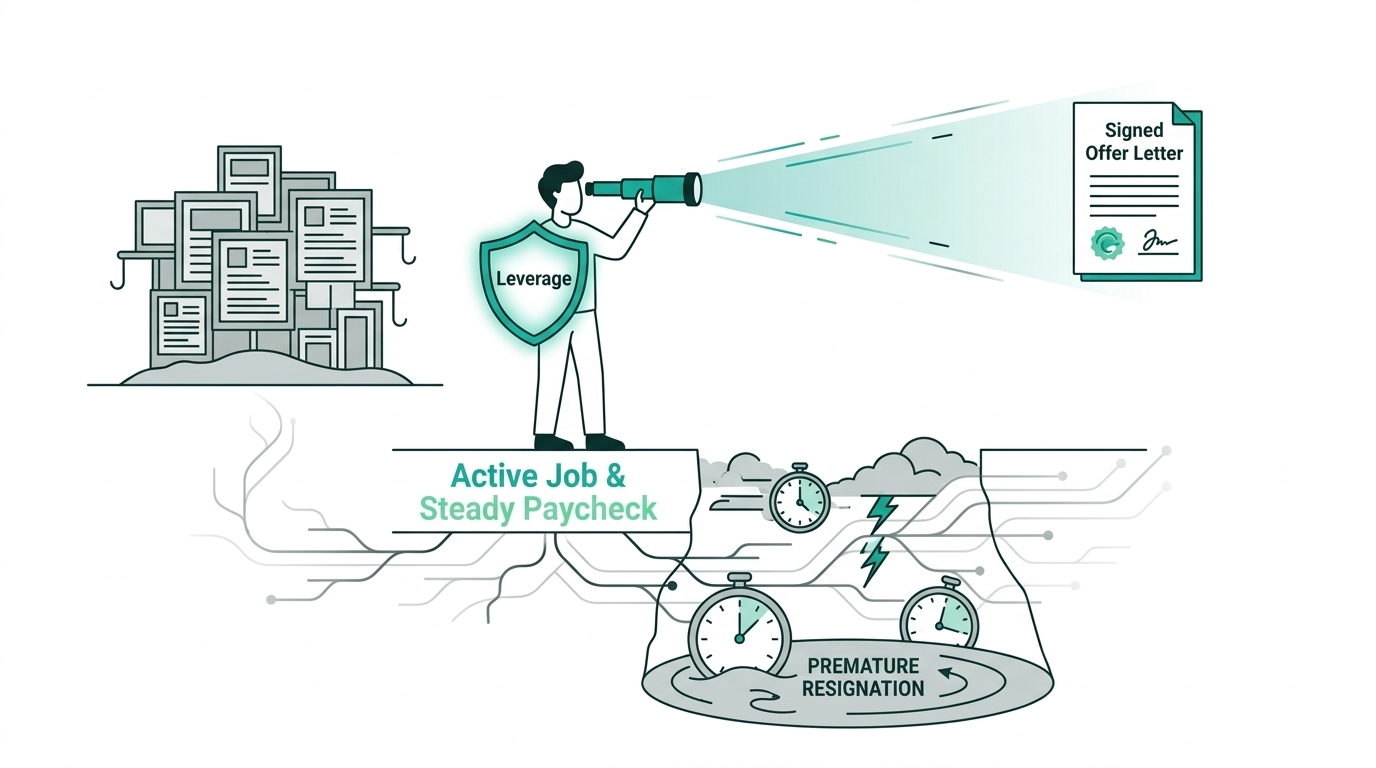
Direct answer: Resigning from a job without another offer in hand feels liberating for forty-eight hours, but in a tight hiring market it strips away your greatest competitive asset: the upper hand. Tech hiring cycles that previously took three weeks now frequently extend past four months. When you walk away prematurely, your callback numbers drop, your salary negotiation power shrinks, and financial pressure forces you to accept the first mediocre offer that crosses your inbox.
Unless a workplace is threatening your physical health or demanding illegal conduct, staying in your seat while interviewing quietly is the only strategy that protects your career trajectory.
The cold math of the current tech market#
Many engineers still operate with memories of the hiring boom of 2021, when anyone with two years of distributed systems experience could drop a two-week notice and collect multiple six-figure offers by the weekend.
That market no longer exists. Companies in 2026 hire defensively, requiring multiple layers of executive sign-off for backfill requisitions. Openings routinely draw hundreds of applicants within hours, and interview loops involve four to six rounds spanning take-home assignments, system design screens, and team assessments.
The consequence is a dramatic expansion in median search duration:
- 2021 average search time: 3 to 6 weeks.
- 2026 average search time: 16 to 24 weeks.
If you step down with three months of living expenses saved, you enter month four with a dwindling bank account and mounting anxiety. That anxiety bleeds into your technical interviews. Candidates who desperately need their next paycheck interview worse than candidates who can calmly walk away from a bad offer.
Why full-time job hunting is an illusion#
A common justification for early resignation is the desire to dedicate eight hours every day to interview preparation. Engineers tell themselves they will review algorithms in the morning, build a systems portfolio in the afternoon, and network through the evening.
In practice, job hunting provides sharply diminishing returns past ninety minutes a day:
- Pipeline velocity is fixed. Applications take minutes, but responses take weeks, meaning you cannot force faster reviews by sitting at your desk all day.
- Unstructured downtime breeds rumination. Interviews happen on company time, and spending your entire day refreshing notifications turns normal hiring delays into catastrophic rejections.
A day job protects your daily routine and guarantees a dependable paycheck. You only need one focused hour before work and one hour in the evening to prepare effectively for upcoming loops.
How unemployment damages your salary negotiations#
Your compensation in a new position is rarely determined by an objective calculation of your engineering ability. It is determined by your alternative options.
When an offer lands and you already have an active salary, you possess total walking power. You can state your compensation requirements clearly, knowing that a failed negotiation simply leaves you where you started. Recruiters know this; they submit top-of-band numbers to tempt passive, employed candidates away from safe positions.
When you are unemployed with rent due, the company holds every card. They recognize your urgency through your immediate start date and your willingness to jump through extra interview hoops. Candidates who resign early routinely accept 15% to 25% lower total compensation just to stop their financial bleed. That salary penalty follows your career earnings for years.
The survival playbook: Managing a toxic environment while searching#
If your manager is micromanaging, holding petty grudges, or playing endless office politics, you do not need to fix the team. You only need to survive it while setting up your exit.
Here is how experienced engineers navigate bad management without quitting early:
1. Shift into emotional detachment#
Stop caring about whether the project succeeds long-term, whether the team architecture is elegant, or whether your manager recognizes your contributions. View your employment strictly as a commercial contract: you supply code and task completion, and they supply direct deposits. Save your emotional energy for your technical interview preparation.
2. Move all communication to writing#
Micromanagers thrive on ambiguous verbal directions that allow them to shift blame later. After every meeting or casual Slack exchange, send a concise summary message: "Following up to confirm our discussion: I will prioritize item A and hold item B until Thursday." Written documentation stops micromanagers from creating false emergencies and protects your performance record.
3. Defend your calendar for interview slots#
Block recurring two-hour focus windows on your calendar under titles like "Deep Work" or "System Profiling." Use these protected blocks to take recruiter screen calls, study system design patterns, or review algorithm problems. If an interview conflicts with an internal meeting, prioritize the interview and decline the internal event with a brief note that you are resolving an urgent deliverable.
4. Let the bad company fund your next step#
Every paycheck you receive while preparing for interviews is money that company is paying you to leave them. Remind yourself of that transaction during frustrating meetings. The company is underwriting your job search runway, keeping your savings account intact while you secure a substantially better role.
The only genuine exceptions#
There are limited circumstances where resigning without an offer is warranted:
- The workplace is demanding you violate the law or commit regulatory fraud.
- The environment has triggered severe, documented physical or psychological health conditions that make basic daily functioning impossible.
- You have twelve months or more of non-retirement liquid cash and intend to step away from the industry intentionally for personal projects.
Outside of those rare situations, do not hand over your notice in anger. Use that frustration as discipline to send targeted applications on day zero, schedule your interviews, and leave on your terms with a signed offer in hand.
Common Questions Answered
See which tech companies are actively hiring right now.
Stop applying to stale ghost listings or hiring freeze teams. Fastlyy's Hiring Pulse monitors real-time hiring velocity across 1,000+ verified tech career pages.