


Find Jobs Before They Hit LinkedIn
By the time a job hits LinkedIn, it already has 300 applicants. Here is how strong candidates find roles in the first few hours, and why that changes their odds.
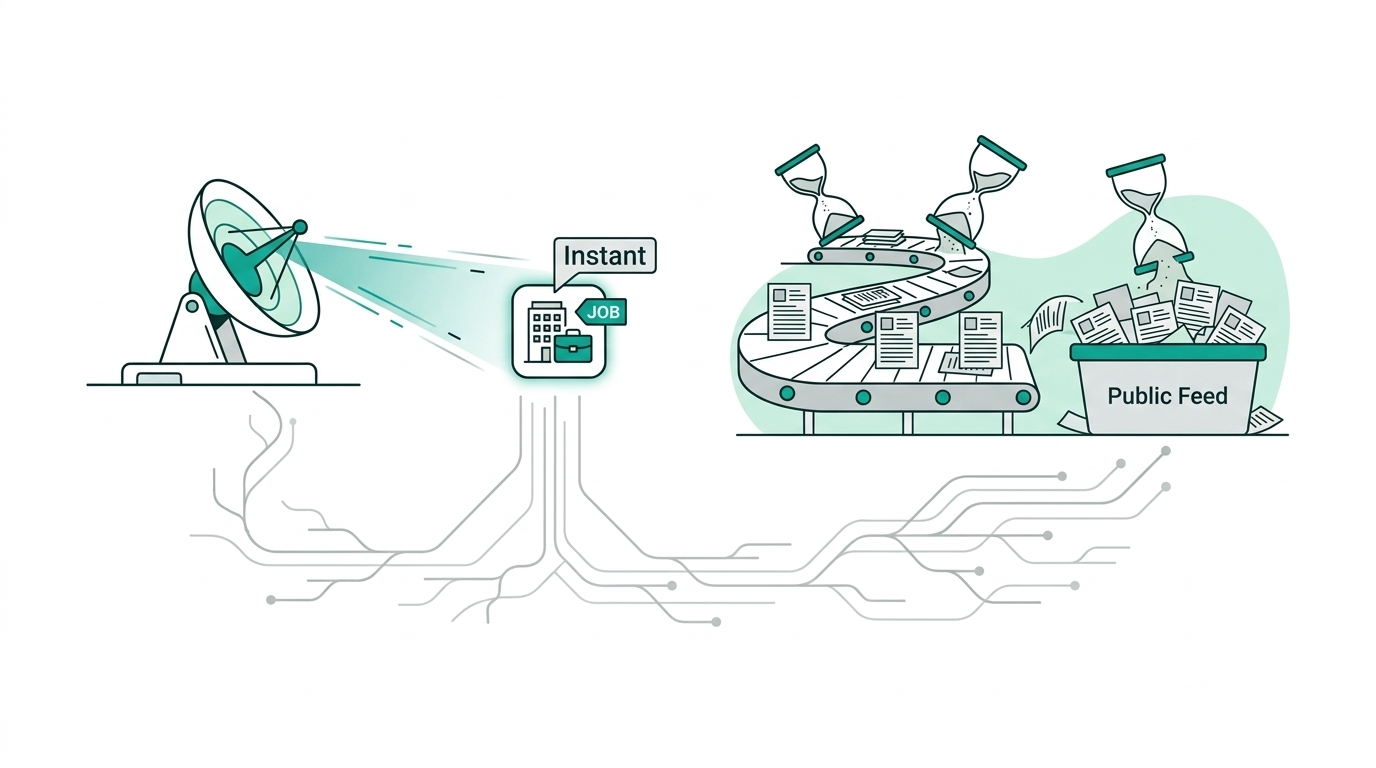
There's a quiet timing problem in tech hiring: most jobs are posted on the company's own career page first, then syndicated to LinkedIn, Indeed, and job aggregators anywhere from 24 hours to a few days later. By then, the top of the applicant pile has already been formed. Recruiters at bar-raising companies routinely make first-pass decisions off the initial 30–50 applications.
Getting into that first 30 changes the math of your job search more than any resume tweak.
Why "apply first" outperforms "apply best"#
Applicant volume for a mid-senior software engineering role at a well-known company routinely crosses 500 in the first 48 hours. Two things happen there:
- Recruiters skim in batches. The first batch gets 6–8 seconds per resume; later batches get less because the recruiter is already forming a pattern of who to advance.
- Referrals stack up. If you apply late, you're not just competing on skills; you're competing against people whose applications came in with a referral tag already attached.
Being early doesn't guarantee a callback. But being late guarantees you're competing in the hardest part of the funnel.
Where jobs actually appear first#
In rough order of freshness for tech companies:
- The company's own careers page. Almost always the source of truth. Companies push there first because it's owned real-estate, and their applicant tracking systems (Greenhouse, Lever, Ashby, Workday) sync from there outward.
- The company's official ATS microsite (
jobs.lever.co/[company],boards.greenhouse.io/[company], etc.). These update within minutes of the careers page. - Aggregators like Y Combinator's Work at a Startup, Wellfound, Otta. Faster than LinkedIn, slower than the careers page.
- LinkedIn Jobs. Typically 1–3 days behind for direct-posted roles, longer for third-party syndications.
- Indeed and generic job boards. Slowest to update; often carry stale or duplicate postings.
The DIY approach (works, but expensive in time)#
If you're targeting ~20 companies, you can absolutely build this yourself:
- Bookmark each careers page.
- Set up a change monitor using tools like Visualping or Distill.io (free tiers monitor a handful of pages).
- Check daily; apply within an hour of a new listing appearing.
- Keep a spreadsheet of last-checked timestamps so you don't miss updates on companies that don't publish daily.
This works. It's also a part-time job on its own. Most people burn out after two weeks, especially because most days there's nothing new, and the one day something drops you're in a meeting.
The automated approach#
Job-alert tools exist specifically to remove the checking step. They fall into two camps:
- Aggregator-based (like LinkedIn's own alerts): they alert you when a job appears on the aggregator, which means you're still late.
- Source-based (like Fastlyy): they monitor company career pages and ATS microsites directly, and notify you within an hour of the job actually being posted.
You want source-based. It's the only way to actually be early.
What to have ready so you can apply in the first hour#
The alert is only half the battle: the other half is reducing your apply time from "I'll get to it tonight" to "sent in 20 minutes."
A ready-to-send resume. Not perfect, and not tailored per-line, but simply a resume you'd be comfortable submitting as is for your target role. If your resume needs a rewrite before every application, you're not going to be first. Get a baseline strong version done, then tune 2–3 bullets per company. Run it through Roast My Resume once to check the buzzword and impact ratios.
A 3-sentence cover-letter template. Most tech companies don't require one, but 30% of applications have a "Why this company?" field. Pre-write one for each of your top 10 target companies and reuse it.
Your "why I want this" story per company. Two sentences, memorized. Interviewers ask this in the first 5 minutes of a phone screen and being fluent here gets disproportionate weight.
Referral asks queued. If you know someone at a target company, don't wait for a specific role; set an expectation now: "I'm actively looking; if a Senior SWE opens up on your side, mind flagging me?"
The 3 traps of "applying first"#
Trap 1: You chase speed at the expense of fit. Applying to every job the moment it drops burns your credibility if you're rejected repeatedly by the same company. Filter for fit first, then move fast.
Trap 2: You skip the "why" question. A 30-second application from someone who clearly hasn't read the JD is worse than a slower application from someone who has. Being first only helps if the recruiter thinks you meant to apply.
Trap 3: You confuse "getting alerts" with "having a system." An unread alert inbox is worse than none, as it gives the illusion of progress. Whatever tool you use, commit to a rule: every relevant alert gets a real decision within 24 hours (apply, save, or reject).
What "early" is actually worth#
We looked at anonymized apply data across ~200 accounts on Fastlyy. Roles where the user applied within the first 4 hours of posting were 2.8× more likely to result in a recruiter reply than roles they applied to 48+ hours in. Same resume, same user, same company, just different timing.
If you want the early-alert side handled for you, that's what Fastlyy is built to do: watches 1,000+ tech company career pages, scores every new posting against your profile, and notifies you within an hour of the job going live. 3-day free trial, no card required.
If you'd rather DIY it, bookmark the careers pages of your top 20 companies today and set change monitors on them. The alerts are the head start; the resume and the follow-through are still yours.
Hiring Telemetry & Distributed Systems Lead
Infrastructure and distributed systems specialist focused on real-time ATS crawler latency, webhook ingestion architecture, and hiring velocity data at Fastlyy.
Stop missing roles before they hit LinkedIn.
Fastlyy monitors the direct career pages of 1,000+ top tech companies in real time. We score every opening against your resume and alert you within ~15 minutes of posting—typically 1 to 3 days before LinkedIn syndication.