


Apply Direct, Not Through Aggregators
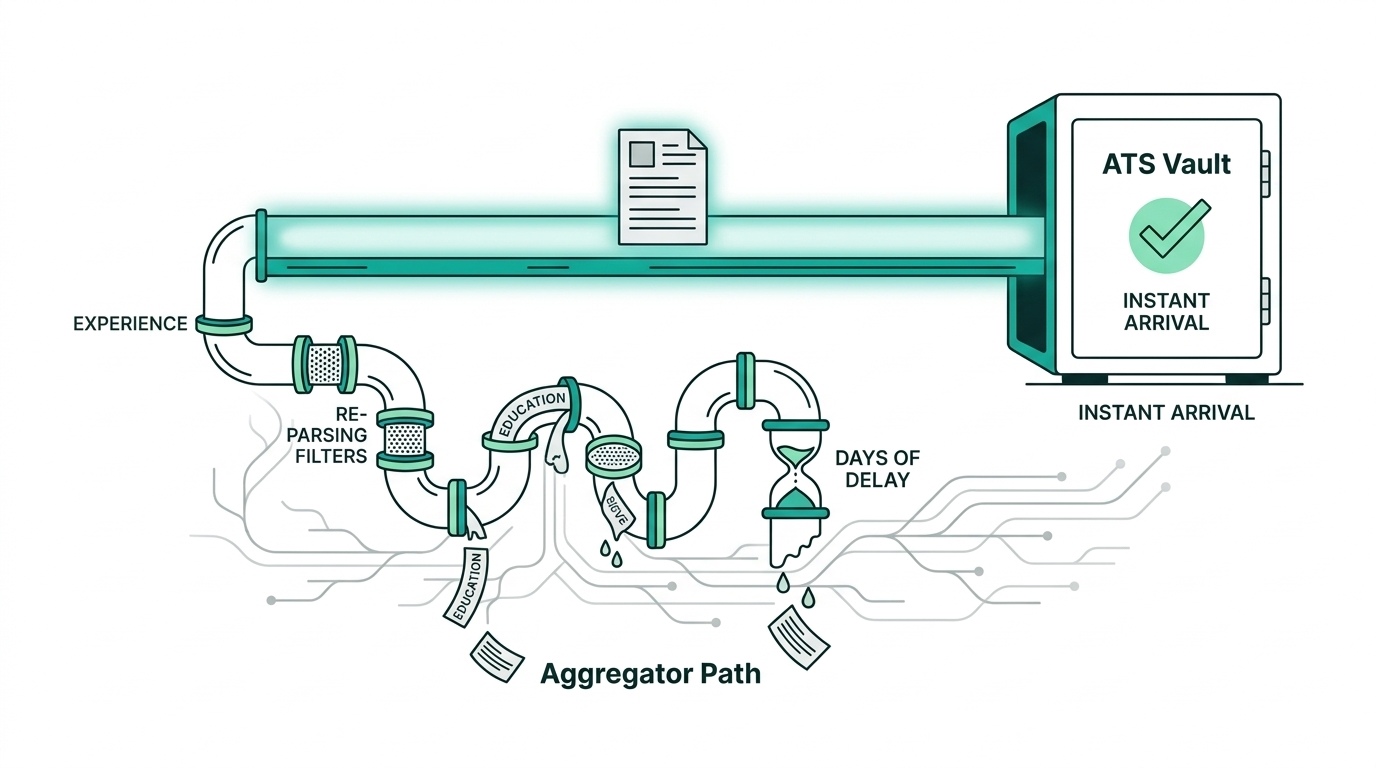
Short answer: when you apply through a third-party board, your resume takes a slower, lossier path to the hiring manager. Applying directly on the company's careers page fixes both problems in one move.
Short answer: when you apply through a third-party board, your resume takes a slower, lossier path to the hiring manager. Applying directly on the company's careers page fixes both problems in one move.
There's a quiet cost to every extra layer between you and the company you want to work for. Job aggregators are convenient. They're also the reason your application is late, sometimes reformatted, and often visible to the hiring team as a lower-signal "external referral" rather than a direct interest.
Why does applying directly matter?#
Companies keep their applicant tracking system (Greenhouse, Lever, Ashby, Workday) on their own domain. That's the system a recruiter actually reads applications in. When you upload your resume there, it lands in the record with your original formatting and every field you filled. When you upload the same resume to an aggregator, that platform re-parses the file, sometimes re-encodes the PDF, and pipes it into the ATS with fields it inferred rather than the ones you typed.
Every re-parse is a place your resume can break. Column layouts get flattened. Dates land in the wrong field. Cover letter fields get truncated at 500 chars because that was the aggregator's limit, not the company's.
Are jobs on aggregators stale?#
Often. Most large aggregators scrape company career pages on a scheduled cadence: every few hours for the biggest brands, and every few days for smaller ones. In between scrapes, roles that are already live on the careers page haven't shown up on the board yet. Direct visitors have already dropped their applications by the time the aggregator catches up.
For competitive roles this compounds. A senior engineering role at a well-known company can accumulate 300+ applicants in the first 48 hours. If the aggregator is a day behind, you're competing against everyone who applied directly on day one plus everyone else who saw the aggregator on day two.
Does applying directly help with the ATS?#
Yes, in two specific ways:
- No re-parse. Your PDF lands in the company's ATS as you uploaded it. Column layouts, spacing, and dates stay intact.
- No inferred fields. The application goes in with the exact answers you gave, meaning the aggregator does not autofill a field based on its guess at your LinkedIn headline.
Neither of those is dramatic on its own. Together they eliminate an entire class of "the parser broke my resume" rejection.
How do you actually find the direct link?#
The company's careers page is almost always at one of these:
<company>.com/careers<company>.com/jobsjobs.<company>.com<company>.<ats>.comwhere<ats>isgreenhouse.io,lever.co,ashbyhq.com,workday.com, ormyworkdayjobs.com
When you're staring at a role on an aggregator, check the "Apply on company site" link; it usually points you to one of these ATS microsites. That's the source of truth. Bookmark the microsite, not the aggregator listing.
The efficiency problem#
Doing this manually across 20 target companies means 20 pages to refresh each morning. That's a chore no one keeps up for more than a week. The solution is not switching to aggregators for convenience (which sacrifices the direct-application advantage), but rather automating the monitoring layer while keeping the application layer direct.
That's what Fastlyy does. We monitor 1,000+ tech company career pages directly and ping you within ~15 minutes when a matching role opens; the link we send you goes straight to the company's own ATS. You get aggregator convenience with career-page freshness, and your application lands in the recruiter's queue with no middleman between it and the hiring team. More on the tradeoffs in How to Find Jobs Before They Hit LinkedIn.
Two practical rules#
- When both are available, apply on the careers page. Every time.
- If the aggregator is the only way you found the role, still click through to the company site to apply. The "Apply Now" button on the aggregator often just deep-links to the company's ATS: use that link directly instead of the aggregator's form.
Neither takes extra effort. Both close the gap between the moment the recruiter sees your application and the moment they see everyone else's.
Fastlyy monitors 1,000+ company career pages so you can apply direct without living in browser tabs. 3-day free trial, no card needed.
Common Questions Answered
Hiring Telemetry & Distributed Systems Lead
Infrastructure and distributed systems specialist focused on real-time ATS crawler latency, webhook ingestion architecture, and hiring velocity data at Fastlyy.
Stop missing roles before they hit LinkedIn.
Fastlyy monitors the direct career pages of 1,000+ top tech companies in real time. We score every opening against your resume and alert you within ~15 minutes of posting—typically 1 to 3 days before LinkedIn syndication.