


The Best Day to Apply for a Job Isn't a Day
The day of the week you apply matters far less than being early on the specific role. Here is what the data actually shows, and why speed beats calendar tricks every time.
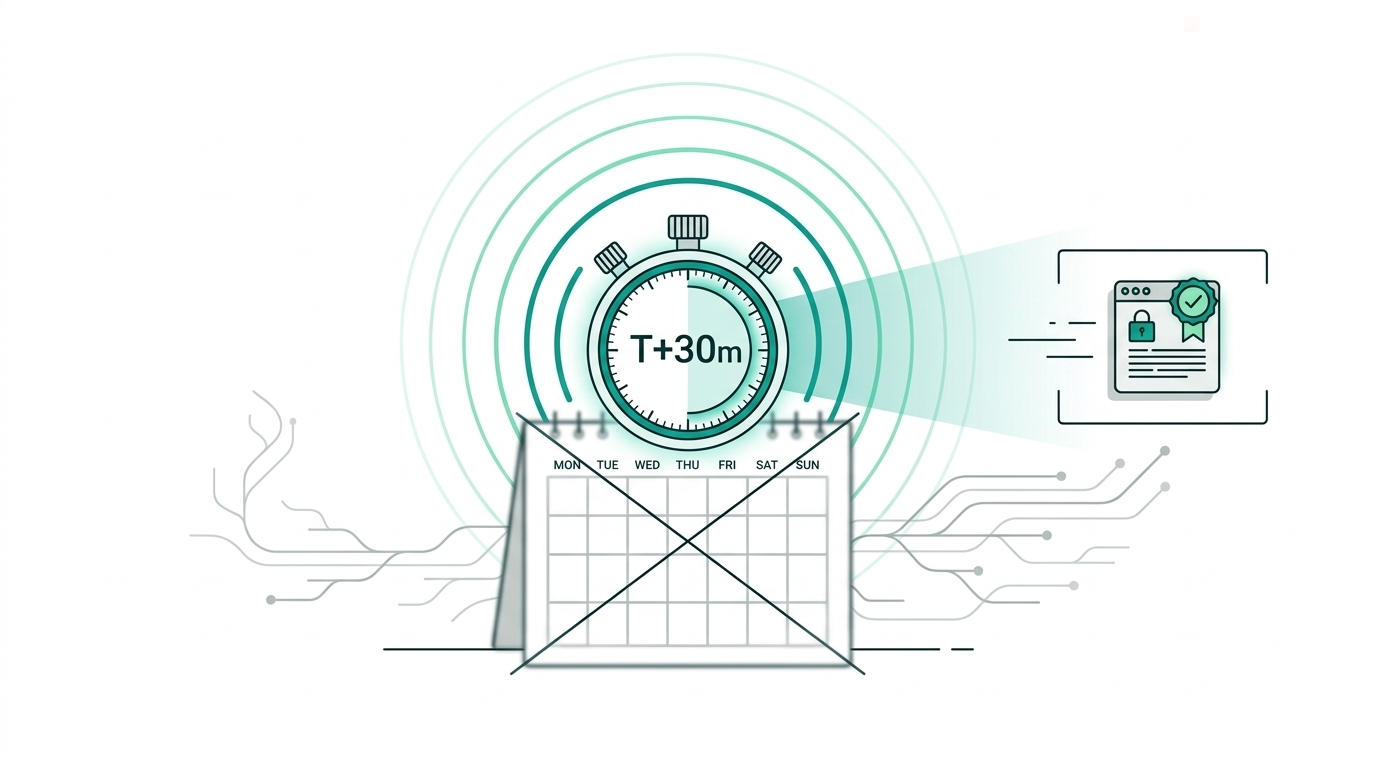
Short answer: The day of the week you apply is a minor detail; the speed at which you apply after an opening appears is what moves the needle. If you must choose between waiting for Tuesday morning or submitting within an hour of a posting going live on a Saturday, submit on Saturday.
The "best day to apply" advice has been recycled online for years, but most of it is folklore.
What is the best day to apply for a job?#
There isn't a single best day. Studies of recruiter response patterns show a mild edge for Tuesday–Thursday mornings, the days recruiters have cleared Monday's backlog and haven't yet checked out for the weekend. That effect is real but marginal.
What matters dramatically more is being early for the specific role. A job that accumulates over 300 applications in its first 48 hours converts responses on the first 30 submissions at multiples of what it does for the next 200. Whichever day of the week those first 30 arrived, that was the day that counted.
Is it bad to apply for jobs on a Friday or weekend?#
No. The notion to avoid applying on Friday stems from a belief that:
- Recruiters will not see your resume until Monday.
- Monday inboxes are flooded with weekend submissions.
- Your application receives minimal attention.
In reality, corporate tech recruiters review submissions in daily batches, frequently re-checking on Monday morning specifically for weekend arrivals. A compelling resume gets read whether it arrives at 3pm on Wednesday or 11pm on Saturday.
More importantly, waiting three days to submit on an "optimal" day costs you far more than any timing bonus. A requisition posted on Friday may have 100 competing applicants by Tuesday morning. Being late is far worse than applying on an off-peak day.
What time of day should you apply for a job?#
Submitting between 6am and 10am local time to the company can offer a slight edge. Recruiters often complete an initial triage pass first thing in the morning, meaning applications near the top of the queue receive a closer initial look.
Again, this serves only as a tiebreaker between candidates who both applied within the first 24 hours. If an application is four days late, time-of-day positioning cannot compensate.
Does applying quickly after a job is posted matter more than the day?#
Yes, and the difference is decisive.
Anonymized application data across approximately 200 tech job seekers showed that applications submitted within the first four hours of posting were 2.8× more likely to result in a recruiter reply than submissions sent to the same company 48 or more hours after publication.
The reason is practical rather than mysterious:
- Recruiters open requisitions with an urgent goal of building an interview shortlist.
- The earliest pool of qualified applicants establishes the baseline standard.
- Subsequent applications are judged against an already-forming shortlist, creating a higher bar for consideration.
Entering the candidate pool during that initial window yields far greater advantages than any calendar strategy.
So when should you actually apply?#
Follow two fundamental guidelines:
- The moment you find a role that fits: Submit promptly with a resume that is already tailored to your core strengths, rather than postponing until later in the week.
- Use Tuesday through Thursday mornings only as a tiebreaker: If two application opportunities are ready simultaneously, prioritize mid-week mornings as a secondary factor.
The preparation that enables immediate applications is what actually gives you an edge:
- A strong master resume that requires only minor bullet adjustments before sending.
- Concise cover-letter templates adaptable within five minutes.
- Prepared talking points for your top-priority target companies.
Having these assets ready allows you to respond within an hour of an alert. Without them, applications are perpetually delayed.
The metric worth optimizing#
Not the day of the week, and not the hour of the day: the elapsed time from when a role is posted to when your application is submitted. Minimizing that interval is the highest-leverage adjustment in modern job searching.
Using tools like Fastlyy to monitor over 1,000 tech career pages in near real-time, combined with a prepared resume, reliably places you inside that critical four-hour window. That operational speed is what consistently drives interview callbacks.
Fastlyy alerts you within ~15 minutes of new roles going live on 1,000+ tech company career pages, so you're apply-ready in the window that matters. Free 3-day trial.
Common Questions Answered
Hiring Telemetry & Distributed Systems Lead
Infrastructure and distributed systems specialist focused on real-time ATS crawler latency, webhook ingestion architecture, and hiring velocity data at Fastlyy.
Stop missing roles before they hit LinkedIn.
Fastlyy monitors the direct career pages of 1,000+ top tech companies in real time. We score every opening against your resume and alert you within ~15 minutes of posting—typically 1 to 3 days before LinkedIn syndication.