Why LinkedIn Job Alerts Are Too Slow for High-Demand Tech Roles
A technical breakdown of LinkedIn's 24-72 hour alert batching delay vs direct ATS career page indexing, and how latency impacts software engineering recruiter callbacks.
Looking for the complete platform comparison? Check out our definitive Fastlyy vs LinkedIn Comparison Guide for full feature-by-feature evaluation tables, pricing teardowns, and recruiter review rates.
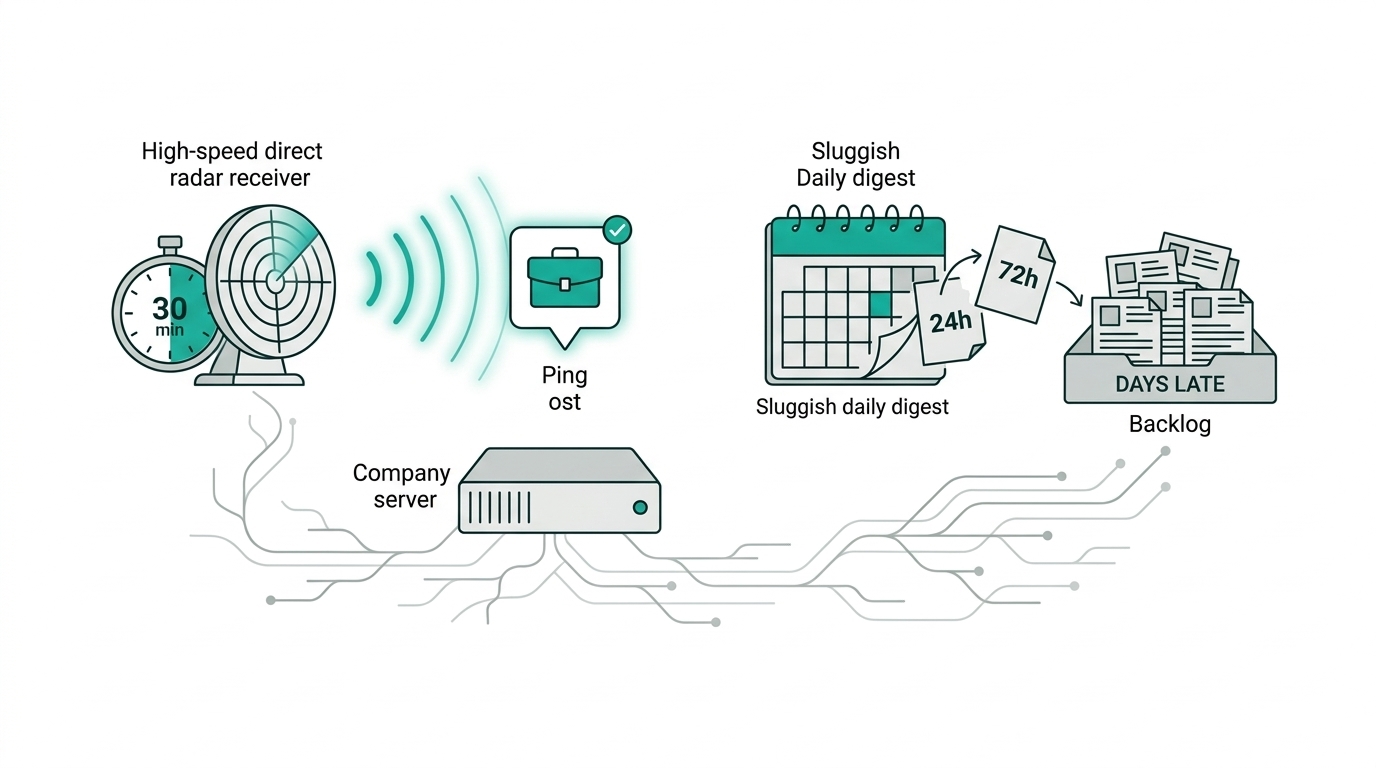
Short answer: Fastlyy watches ~1,000 tech company career pages directly and pings you within ~15 minutes of a new role going live. LinkedIn Job Alerts run on a daily digest and typically surface roles hours to days after they hit the career page. If you're targeting competitive tech roles, that gap is the difference between being in the first 30 applicants and being applicant #400.
How is Fastlyy different from LinkedIn Job Alerts?#
Fastlyy monitors the source (the company's own ATS microsite, including Greenhouse, Lever, Ashby, and Workday) and pushes alerts within ~15 minutes. LinkedIn Job Alerts index LinkedIn's own job board, which is one layer downstream of the career page and is 24–72 hours slower for most tech roles.
Is Fastlyy faster than LinkedIn Job Alerts?#
Yes, especially on roles from tracked companies. LinkedIn's own index syncs from the company's careers page on its own cadence (and sometimes not at all if the company hasn't set up direct posting). Fastlyy fetches the ATS microsite directly, which is why the median alert time is ~15 minutes vs LinkedIn's 24–72 hours.
Why the speed matters: at bar-raising tech companies, applications routinely cross 300 in the first 48 hours. Being in the first 30 external applicants gets disproportionate recruiter attention. We broke that down in How to Find Jobs Before They're Posted on LinkedIn.
Does Fastlyy replace LinkedIn?#
No. Use both. Fastlyy is best for real-time alerts on your top 10–20 target companies. LinkedIn is best for wider coverage across industries, warm intros via mutual connections, and the referral flow at your target companies.
Feature-by-feature#
| LinkedIn Job Alerts | Fastlyy | |
|---|---|---|
| How fast after posting? | Hours to days | Within ~15 min |
| Alerts based on | LinkedIn's own index | Company career pages directly |
| AI match score against your resume | Basic (Premium only) | On every job, tuned to your resume |
| Which companies? | Anyone who posts to LinkedIn | 1,000+ tracked tech companies |
| Notification frequency | Daily digest | Real-time, as roles go live |
| Cost | Free basic; ~$40/mo Premium | Free 3-day trial, one-time plans after |
| Application tracking | Basic (Premium) | Built in |
What is LinkedIn better at?#
- Sheer coverage. LinkedIn indexes millions of listings across every industry. If you're in a non-tech field or looking outside the top ~1,000 tech companies, LinkedIn covers ground Fastlyy doesn't.
- Networking as part of applying. The "apply-with-connection" flow is genuinely useful, and no aggregator replicates it.
- Company insights. Employee counts, growth graphs, org chart visibility: LinkedIn owns this.
- Free tier. LinkedIn's free tier will still show you many of the same jobs; you'll just see them several days later.
What is Fastlyy better at?#
- Speed. Alerts within ~15 minutes of the role appearing on the company's actual careers page.
- Precision. Match score against your uploaded resume for actual keyword overlap and role fit (not the fuzzy "recommended jobs" LinkedIn generates from your public profile).
- Narrow target set. "Watch these 20 companies for me" with real-time alerts on just those beats scrolling a general feed.
- Free adjacent tools. Roast My Resume is free with no signup. Hiring Pulse gives a real-time view of which companies and locations are hiring most across the tracked set.
When should you use which?#
Use LinkedIn if:
- You're looking outside the tracked tech-company tier.
- You want to warm up an application with a mutual connection.
- You're passively browsing and okay with a slower cycle.
Use Fastlyy if:
- You're actively targeting tech companies in the top ~1,000.
- You want alerts in the first hour, not the third day.
- You want match scoring against your actual resume, not against your LinkedIn "Open to Work" profile.
Use both if: you're serious about the search. LinkedIn for the wide net and the referrals; Fastlyy for the "apply first" edge on your top-20 target list.
How much does Fastlyy cost compared to LinkedIn Premium?#
Fastlyy is a one-time plan (starting at {{PRICE_7D}} for 7 days, no recurring billing) with a 3-day free trial that requires no credit card. LinkedIn Premium is $39.99/month, recurring. If you land the offer inside a 30-day window, Fastlyy's total cost is a fraction of a single month of Premium.
Is it worth switching to Fastlyy?#
If your top 20 target companies are on the tracked list, yes: being alerted within 15 minutes of a role opening beats every other optimisation you can make. Check the tracked companies list on the pricing page before you decide.
Ready to see how much of a difference "first alert" makes? Start the 3-day free trial with no card required. Or try Roast My Resume for free to test the platform first.
Common Questions Answered
Hiring Telemetry & Distributed Systems Lead
Infrastructure and distributed systems specialist focused on real-time ATS crawler latency, webhook ingestion architecture, and hiring velocity data at Fastlyy.
Stop missing roles before they hit LinkedIn.
Fastlyy monitors the direct career pages of 1,000+ top tech companies in real time. We score every opening against your resume and alert you within ~15 minutes of posting—typically 1 to 3 days before LinkedIn syndication.