


15 Resume Buzzwords to Cut in 2026
Every recruiter has seen 'passionate self-starter' 4,000 times this month. Cut these 15 phrases and replace them with things a human actually earns.
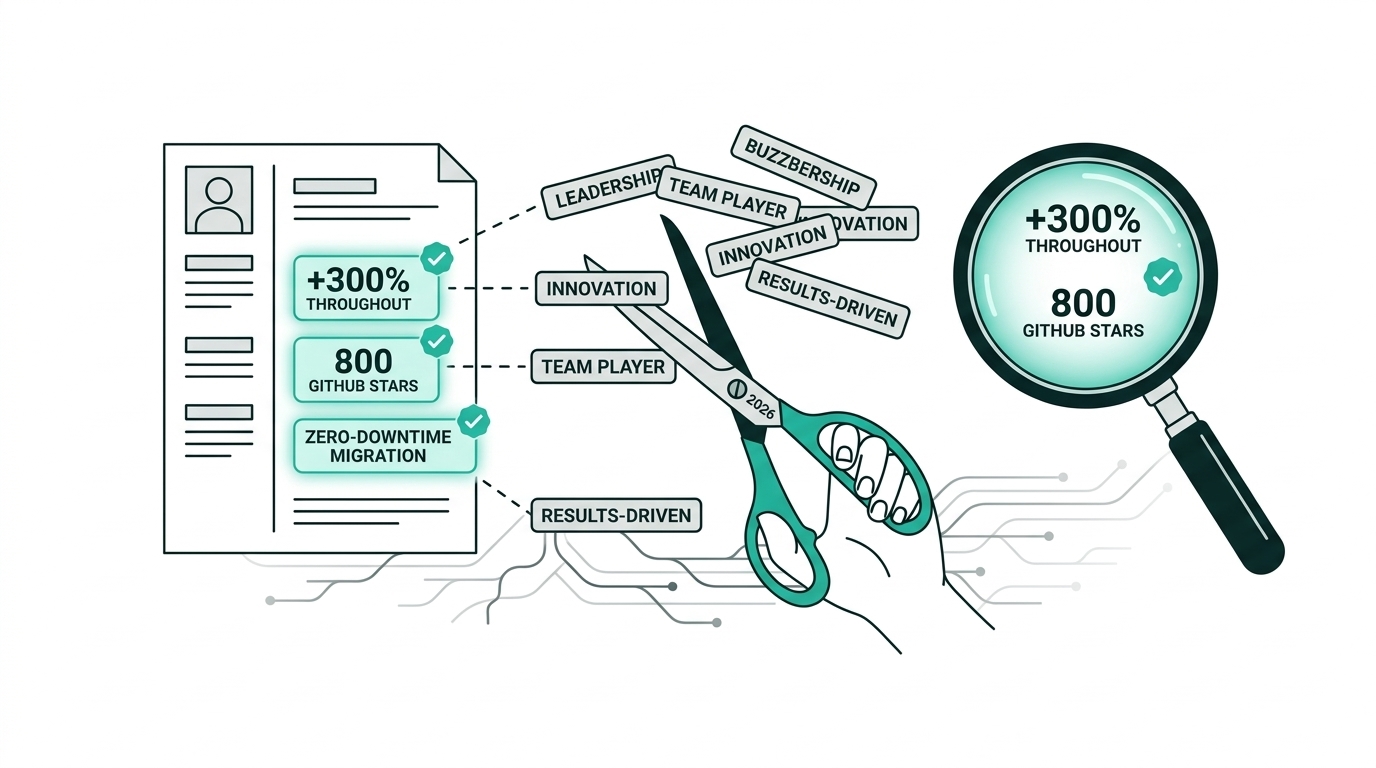
Recruiters skim resumes for 6–8 seconds on the first pass. The words below get eyes to glaze over faster than a stack of Kubernetes tickets. Cut them, replace them with something you can defend in a 45-minute interview, and your resume immediately reads like a person and not a LinkedIn autocomplete suggestion.
Why buzzwords quietly kill your resume#
A buzzword is any phrase that could describe you or any of the other 400 people who applied. Recruiters are pattern-matchers by trade: the moment they hit a phrase that carries zero signal, they skip the whole bullet. If two-thirds of your bullets read like that, your resume converts like a cold email.
The rule for every line on a resume is simple: would this sentence be true of a random person on the same team? If yes, delete it.
The 15 offenders (and better replacements)#
1. "Passionate about [X]"#
Nobody puts "indifferent about" on a resume, so "passionate" carries no information. Show it through what you built after hours or which conferences you spoke at.
Instead: "Wrote and maintained an open-source Postgres extension (~800 GitHub stars)."
2. "Self-starter"#
Every applicant claims this. Show a project you started without being asked.
Instead: "Proposed and shipped an internal on-call dashboard that cut noisy pages by 62%."
3. "Results-driven"#
Numbers are results. Show them.
Instead: "Reduced p99 checkout latency from 1.4s → 380ms."
4. "Team player"#
The absence of "team player" doesn't imply you're a lone wolf. Prove collaboration with a specific outcome from working with someone.
Instead: "Partnered with data science to launch a fraud model that saved $2.1M in year one."
5. "Detailed-oriented"#
This one gets funnier when it's misspelled ("detailed orientated", a real and common resume typo). If you're detail-oriented, your typography, alignment, and dates should show it.
Instead: just present a resume with zero typos, consistent tense, and dates that line up.
6. "Synergy"#
Whatever it once meant, it's now a running joke. Nobody wants to work with someone who says "synergy" in a review meeting either.
Instead: "Got engineering and support ops using a single incident-severity taxonomy."
7. "Rockstar / Ninja / Guru / Wizard"#
Job titles for people who peaked in 2013. Also, "ninja" implies stealth, which is the opposite of what senior ICs get promoted for (visible impact).
Instead: the actual title. "Senior Software Engineer" reads as more senior than "Backend Ninja."
8. "Think outside the box"#
The box is fine. Companies want people who ship inside the box on time and outside the box when the box is on fire.
Instead: "Identified a race condition three teams had missed; fix cut duplicate charges by 92%."
9. "Hardworking / Dedicated"#
Baseline expectation, not a differentiator.
Instead: show sustained ownership: "Owned the ingestion pipeline for 3 years across two org restructures."
10. "Fast learner"#
Everyone claims this. Prove it with a role shift or a stack change.
Instead: "Switched from Java to Go in Q1; owned a new payment service by Q3."
11. "Excellent communication skills"#
Your resume itself is the sample. If it's a wall of buzzwords, this line is a lie.
Instead: "Authored the platform team's public API guidelines, adopted by 14 services."
12. "Guru of [X] / Expert in [X]"#
"Expert" is subjective. Replace with a proof point that implies expertise.
Instead: "Migrated 40+ microservices to Istio; wrote the internal training doc."
13. "Utilized"#
Just say "used." Every "utilized" on a resume is somebody trying to sound unnecessarily formal.
Instead: "Built high-throughput payment endpoints using gRPC and Protobuf."
14. "Spearheaded"#
Overused and vaguely corporate. The same applies to "orchestrated," "leveraged," and "drove."
Instead: "Led the migration to Postgres" or "Built the initial checkout service" (direct, plain verbs age better).
15. "9+ years of experience"#
Years don't imply skill. Someone with 3 years at a high-throughput company often outperforms 10 years of maintenance work.
Instead: Lead the resume with a two-line summary that names your core domain and impact, then let individual bullet points provide evidence.
The one line every bullet should pass#
[Strong verb] → [what you did] → [with what tech / for whom] → [with what measurable result].
Every bullet without a number, a scale, or a named outcome is a candidate for revision.
Where this hurts you most#
Two places:
- ATS review: Modern ATS platforms rarely filter for buzzwords automatically, but human recruiters do when reviewing search hits. Their manual filter decides whether you get a callback. See our ATS resume checklist for 2026 for technical details.
- Technical screens: At engineering-led organizations (Anthropic, Stripe, Netflix), the initial resume screen is frequently handled by engineers. Engineers read bullets literally; vague claims get scored as weak signal. If you're targeting one of those, read how to get hired at Anthropic.
Test your own resume in 60 seconds#
Upload your resume to Roast My Resume to flag buzzwords and see how many bullets carry quantifiable metrics. It is free and requires no account.
If more than a third of your bullets get flagged, that ambiguity is usually why interview invitations aren't coming through.
Staff Tech Recruiter & ATS Research Lead
Former senior technical recruiter with 9+ years screening thousands of software engineering pipelines across Tier-1 tech employers and high-growth startups.
Are these buzzwords secretly killing your interview rate?
Run your resume through Fastlyy's free Roast My Resume engine. Our AI scans for ATS parsing traps, cliché phrases, and weak metrics—giving you a brutal, honest score and exact bullet rewrites in 30 seconds.