

How to Get Hired at OpenAI in 2026: Engineering Roles, Tech Stack, & Interview Loop
A complete insider guide to landing a software engineering or research role at OpenAI in 2026: required skills, interview stages, coding rubrics, salary bands, and how to apply before headcount caps.
Direct answer: Getting hired at OpenAI in 2026 requires exceptional distributed systems craft, rapid prototyping proficiency, and the ability to operate in an ambiguous, hyper-scaling environment. Most technical hires are Members of Technical Staff (MTS) rather than pure research PhDs. Because OpenAI roles receive thousands of applications within 48 hours, catching postings the moment they hit the careers page is critical.
Below are OpenAI's engineering tracks, its interview loop stage by stage, what it pays in 2026, and how to apply early.
1. Technical Tracks at OpenAI#
OpenAI organizes its engineering workforce into distinct technical tracks. Understanding where your skillset maps is the first step:
| Track | Primary Responsibilities | Core Stack & Technologies |
|---|---|---|
| Infra & Supercomputing | GPU cluster orchestration, network fabric optimization, checkpointing, distributed training stability | Kubernetes, Slurm, PyTorch, C++, CUDA, Triton, InfiniBand |
| API & Platform | Serving endpoints at global scale, developer platform, rate limiting, low-latency streaming inference | Python, Rust, Go, Redis, Kafka, Envoy, PostgreSQL |
| Applied AI / Product | ChatGPT consumer experience, canvas features, search integrations, agent workflows | Next.js, React, TypeScript, Python, FastAPI, WebSockets |
| Safety & Alignment | Red-teaming infrastructure, automated evals, RLHF pipelines, guardrails | Python, PyTorch, Ray, eval frameworks, HuggingFace |
| Data & Pretraining | Massive multimodal ingestion, synthetic data pipelines, filtering & deduplication | Spark, Ray, Trino, Rust, Cloud storage pipelines |
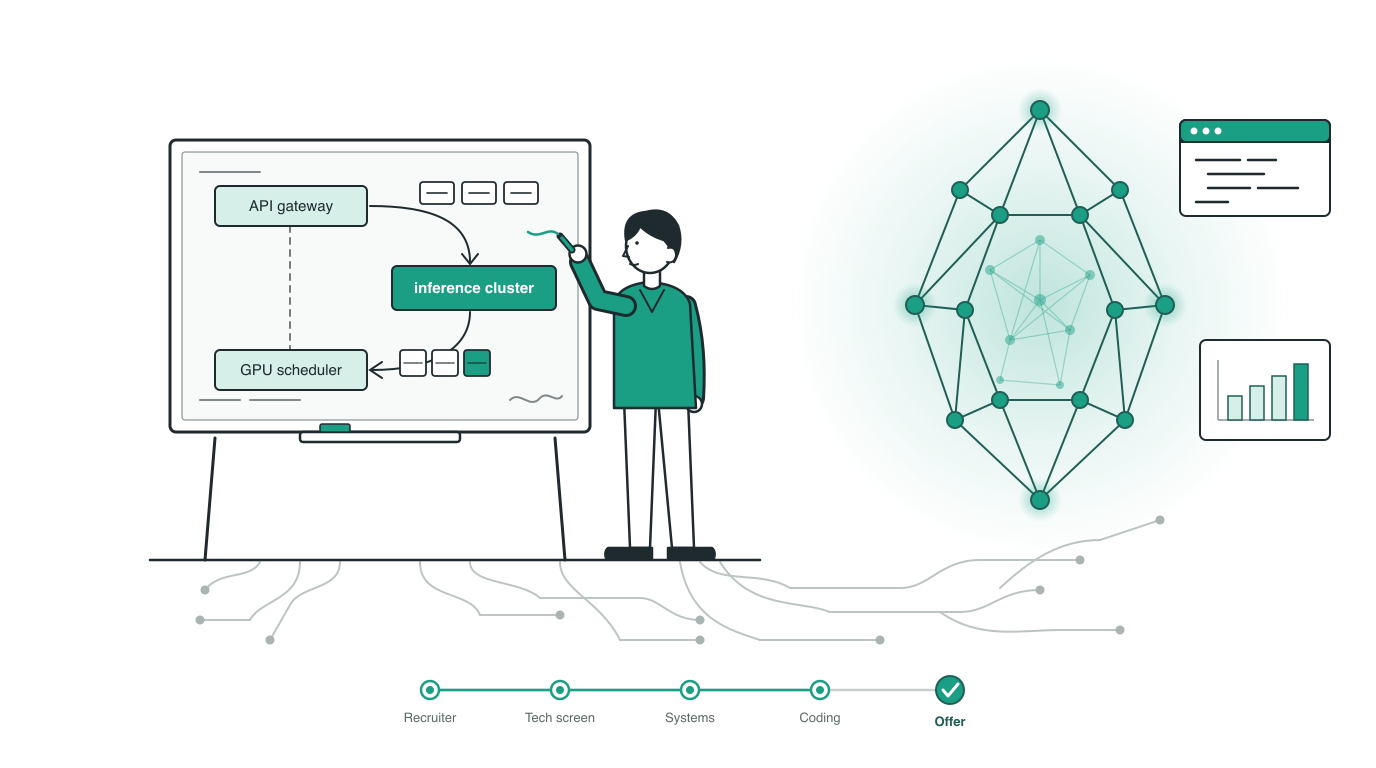
2. The 5-Stage OpenAI Interview Loop#
OpenAI’s interview process is renowned for being pragmatic and hands-on rather than relying on abstract, trivia-style LeetCode riddles.
[ Stage 1: Recruiter Call ] (30 min)
         │
         ▼
[ Stage 2: Technical Screen ] (60 min — Live Coding or System Design)
         │
         ▼
[ Stage 3: Systems & Scalability Deep Dive ] (60 min)
         │
         ▼
[ Stage 4: Real-world Debugging / Pair Coding ] (60 min)
         │
         ▼
[ Stage 5: Values, Execution & Culture Fit ] (45 min)
Stage 1: Recruiter Screen (30 minutes)#
A conversation covering your background, most complex projects, understanding of OpenAI's mission, and target role level. Recruiters verify timeline expectations, visa status, and current compensation.
Stage 2: Technical Screen (60 minutes)#
Usually conducted over CoderPad or Google Meet:
- For Infra/Platform: Concurrency problems, thread safety, asynchronous event loops, or designing a distributed rate limiter.
- For Product/Full Stack: Building a real-time collaborative feature or interactive streaming UI component with TypeScript and Python.
Stage 3: Systems & Scalability Deep Dive (60 minutes)#
Design a large-scale system relevant to OpenAI's operational challenges:
- Example: Design an asynchronous batch inference pipeline handling 100,000 requests/second with variable token lengths and strict p99 latency guarantees.
- Evaluation criteria: Failure domain isolation, backpressure handling, cache coherence, and GPU memory utilization awareness.
Stage 4: Real-World Debugging & Pair Coding (60 minutes)#
Rather than writing an algorithm from scratch, you are often dropped into a pre-existing codebase with broken unit tests, race conditions, or performance bottlenecks. You are evaluated on:
- How methodically you read stack traces and isolate root causes.
- Your terminal fluency, git hygiene, and testing discipline.
- Whether you write readable, production-grade clean code under pressure.
Stage 5: Collaboration, Velocity, & Mission (45 minutes)#
Conducted by an engineering director or lead. Focuses on high agency, operating with minimal guidance, handling fast-moving pivots, and safety awareness.
3. What Sets Apart Successful Candidates?#
Recruiters and hiring managers at OpenAI consistently highlight four differentiators:
- High Agency & Autonomy: OpenAI functions more like a cluster of high-intensity startups than a traditional FAANG corporate structure. Candidates who wait for precise specs struggle; candidates who identify bottlenecks and write the fix themselves get hired.
- A Solid Grasp of LLM Limits: You don't need to invent new transformer architectures, but you must understand why KV-caching matters, how context window size impacts memory footprint, and how latency scales with batch size.
- Rock-Solid Distributed Systems Basics: Concurrency primitives, distributed locking, idempotent APIs, and resilient data pipelines are tested rigorously.
- Strong Open Source or Public Artifacts: Having public contributions to frameworks like vLLM, LangChain, Ray, PyTorch, or having built notable AI developer tooling creates an immediate advantage.
4. OpenAI Compensation Benchmarks (2026)#
OpenAI offers some of the most competitive compensation packages in tech. Compensation is structured as base salary plus Profit Participation Units (PPUs), which track company valuation and equity liquidity programs:
| Level | Role Equivalent | Base Salary | Equity (PPU) / Year | Total Comp (Est.) |
|---|---|---|---|---|
| L4 | Member of Tech Staff (MTS) | $200k – $250k | $120k – $200k | $320k – $450k |
| L5 | Senior MTS | $250k – $320k | $200k – $400k | $450k – $720k |
| L6 | Staff MTS | $320k – $400k | $450k – $800k | $770k – $1.2M+ |
Note: Compensation varies based on location (San Francisco HQ commands top band; select remote roles adjust by geographic tier).
5. The Application Strategy: Beat the 48-Hour Cap#
OpenAI rarely leaves engineering job postings open for more than a few days because each post attracts over 2,000 applicants. If you apply when the job is already featured on LinkedIn, your application lands at the bottom of an insurmountable pile.
To maximize your odds:
- Monitor direct careers pages: OpenAI updates their internal Greenhouse feed before jobs syndicate to LinkedIn or Indeed.
- Tune your resume for keyword relevance: Ensure your experience highlights high-scale metrics (QPS, GPU utilization, latency reduction). Use our free Roast My Resume analyzer to identify gaps before submitting.
- Apply within the first 6 hours: Using real-time career monitoring tools like Fastlyy ensures you receive an instant alert within 15 minutes of an OpenAI posting going live.
Summary Checklist for OpenAI Aspirants#
- Master asynchronous programming and distributed systems primitives.
- Build and deploy an end-to-end project that uses streaming APIs and function calling, backed by a custom eval pipeline.
- Polish your resume with quantified engineering impact (latency, cost savings, throughput).
- Set up automated alerts to catch new OpenAI openings on day zero.
Common Questions Answered
Principal Engineering Career Advisor
Ex-FAANG hiring committee member and career mentor helping software engineers navigate technical interview bars, leveling calibrations, and offer comparisons.
Want alerts the minute OpenAI posts a new engineering role?
Engineering requisitions at OpenAI hit applicant caps within 48 hours. Fastlyy monitors their direct career pages every 15 minutes, alerting you 1 to 3 days before the role syndicates to LinkedIn.